ANSI vs ISO Lumens: Differences, Accuracy & How to Choose a Projector
Two projectors with the same advertised brightness of 800 lumens may produce noticeably different image brightness on the screen. This is because different products may use different brightness measurement methods, optical systems, and testing conditions.
What is the difference between ANSI lumens and ISO lumens? Which one is more accurate? This article explains the definitions, measurement methods, and conversion issues related to these two brightness standards. It also uses Magcubic products as examples to help consumers and buyers better understand projector brightness specifications and choose the right product.
XINYIHUI looks at ANSI and ISO lumens from the perspective of projector manufacturing and real-world use. We will cover their definitions, background, measurement methods, key differences, conversion, and other factors that affect projected image quality. We will also use actual Magcubic product specifications to help readers choose a projector based on their room and brightness needs.
1. What Are ANSI Lumens and ISO Lumens?
First, it is important to understand what lumens mean.
A lumen is a unit of luminous flux. It measures the total amount of visible light emitted by a light source. For projectors, the lumen rating is an important reference for understanding light output.
However, projector brightness does not depend only on the light source. The entire optical system also affects the final result. Therefore, when looking at projector brightness specifications, it is important to understand not only the number but also the measurement method used.
1.1 What Are ANSI Lumens?
ANSI lumens are a widely used projector brightness measurement. The measurement method is based on relevant ANSI projector brightness measurement standards.
Unlike measurements that only look at the theoretical light output of an LED light source, ANSI brightness measurement focuses on the light output of the complete projection system.
When a projector operates, light passes through the lens, optical components, and LCD panel before forming an image on the screen. During this process, optical efficiency, component design, and light loss all affect the final projected brightness.
As a result, even if two projectors use light sources with the same specifications, their projected images may differ in brightness because their optical systems differ.
1.2 What Are ISO Lumens?
ISO lumens refer to brightness specifications associated with the International Organization for Standardization (ISO) and its projector specification framework.
One important reference is ISO/IEC 21118:2020, titled Information technology — Office equipment — Information to be included in specification sheets for data projectors.
This standard mainly defines the information that should be included in data projector specification sheets and how that information should be presented. Its purpose is to help manufacturers display projector specifications in a more consistent and standardized way.
ANSI lumens and ISO lumens are both related to luminous flux. What matters most is the measurement method used for the product, the testing conditions, and how the manufacturer reports the final result.
2. How Are ANSI Lumens and ISO Lumens Measured?
2.1 ANSI Lumens: Measurement Method and Principle
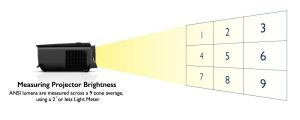
One widely used ANSI projector brightness measurement method calculates the total light output by measuring illuminance at multiple points across the projected image.
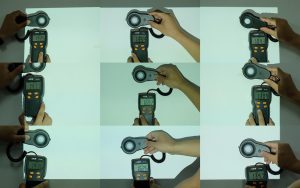
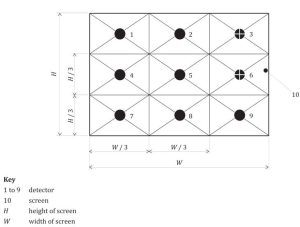
A common nine-point measurement method divides the projected image into a 3 × 3 grid, with illuminance measured at the center of each of the nine sections.
The basic measurement process is as follows:
- Place the projector in the required test environment and display a white test image.
- Set the projector’s image mode and other settings according to the test requirements.
- Divide the projected image into nine equal areas.
- Use a suitable lux meter to measure the illuminance at the center of each area.
- Calculate the average of the nine measurements.
- Multiply the average illuminance by the projected image area to obtain the luminous flux.
Projected Luminous Flux = Average Illuminance × Projected Image Area
Here: Average illuminance is measured in Lux; projected image area is measured in square meters; the calculated result is expressed in Lumens.
For example, if a projector produces an average illuminance of 400 Lux across a projected image area of 2 square meters, the calculation is: 400 × 2 = 800 Lumens. This is only an example to explain the calculation. It does not represent the actual test result of any Magcubic projector.
The advantage of measuring multiple points is that it provides a better view of light output across the entire image, rather than judging overall brightness from a single measurement at the center.
However, to confirm whether a test fully complies with a specific version of an ANSI standard, the complete requirements, testing conditions, and measurement equipment must also be considered.
2.2 ISO Lumens: Measurement Method and Principle
ISO/IEC 21118 requires light output to be measured on the projected image and reported based on the average value of production units.
2.3 Main Differences Between ANSI and ISO Measurement Standards
ANSI brightness measurement methods and the ISO projector specification framework are related, but they are not exactly the same. The main difference is that one focuses on projector brightness measurement, while the other covers projector specification information and how it should be presented in a standardized format.
| Comparison | ANSI Lumens | ISO/IEC 21118 |
|---|---|---|
| Standard source | Relevant ANSI measurement standards | International Organization for Standardization |
| Main purpose | Measure projected light output | Standardize information and formats in projector specification sheets |
| Technical focus | Brightness measurement and calculation | Product specifications and how they are presented |
| Main value | Helps compare projector light output | Helps standardize product specification reporting |
| Product comparison | Testing conditions must be comparable | Actual brightness measurement methods should be checked |
| Fixed conversion formula | No universal fixed formula | No universal fixed formula |
3. ANSI vs ISO Lumens: What Are the Differences Between These Two Brightness Standards?
If one projector is rated at 1,000 ANSI Lumens and another is rated at 1,000 ISO Lumens, can we assume that they produce exactly the same screen brightness? The answer is no. They cannot be compared directly without looking at the measurement methods and testing conditions.
3.1 Main Differences Between the Two Standards
ANSI mainly focuses on measuring the actual light output of a projector, while ISO/IEC 21118:2020 mainly standardizes the information included in data projector specification sheets and how it is presented. The two should not be treated as exactly the same measurement standard. When comparing products, it is important to check the specific measurement methods and testing conditions.
3.2 Which Is More Accurate, ANSI or ISO Lumens?
It is not possible to simply say that one is more accurate than the other. The reliability of a measurement mainly depends on the measurement method, equipment accuracy, testing environment, and whether the manufacturer reports the results correctly.
3.3 Do Projectors with the Same Lumen Rating Have the Same Actual Brightness?
Not necessarily. Even if two projectors have the same advertised lumen rating, their actual image performance may still differ. Factors include optical efficiency, brightness mode, color settings, image uniformity, and screen gain.
4. How to Convert ISO Lumens to ANSI Lumens
There is currently no universal official conversion formula that can accurately convert every ISO-related brightness rating into an ANSI measurement result across all projector models.
4.1 Is There a Fixed Conversion Formula Between ISO Lumens and ANSI Lumens?
No. There is no fixed conversion ratio that applies to every projector. Different products may have different testing conditions, image modes, measurement procedures, and optical performance.
For example, multiplying a projector’s advertised 800 ISO Lumens by an assumed conversion ratio does not produce a verified ANSI measurement result. It is only an estimate based on a preset ratio.
4.2 How to Compare ISO Lumens and ANSI Lumens Correctly
When comparing projectors from different brands, you can follow these steps:
- Check whether the product is rated in ANSI Lumens, ISO Lumens, or regular Lumens without a clearly stated measurement method.
- Ask the manufacturer for a brightness test report and check the measurement standard and testing conditions.
- Compare the results together with native resolution, optical performance, and the actual viewing environment.
This approach also helps distributors and retailers prepare more accurate product specification sheets and avoid misleading brightness comparisons between different brands.
5. What Other Factors Affect Projector Image Quality Besides Lumens?
Brightness is important, but it is only one part of projector performance. Other factors also affect the final viewing experience:
- Native Resolution: Determines the basic image detail and sharpness. Native 1080P resolution is not the same as supporting a 1080P input signal.
- Color Brightness: Affects how bright and vivid colors appear on the screen.
- Contrast Ratio: Affects the difference between bright and dark areas, as well as black levels.
- Throw Ratio: Determines the relationship between projection distance and image size.
- Screen Gain: Different screen materials affect the brightness viewers actually see.
- Ambient Light: Stronger ambient light generally requires a brighter projector.
6. How Many Lumens Do You Need for a Home Theater Projector?
6.1 How Many Lumens Do You Need in a Dark Room?
For a bedroom or home theater with good light control, the required brightness is generally lower than in a room with strong ambient light. For a dedicated home theater with a 100–120-inch screen, the recommended reference range is approximately 600–2,000 ANSI Lumens when ambient light can be controlled. Actual results also depend on screen gain, image size, and personal viewing preferences.
6.2 How Many Lumens Do You Need for a Living Room Projector?
Living rooms usually have more changing light conditions than bedrooms. For example, the room may be dark when watching movies at night, but natural light from windows and indoor lighting can affect the image during the day.
Magcubic recommends considering projectors with at least 800 ANSI Lumens for living rooms with some ambient light. An ambient light rejecting screen may also help improve the viewing experience. For brighter environments, projectors with 2,000 ANSI Lumens or more can be considered.
6.3 How Many Lumens Do You Need for Outdoor Projection?
Outdoor projection is particularly sensitive to ambient light. Watching a movie in a dark environment after sunset is very different from watching it during dusk or in an area with streetlights.
Magcubic currently provides the following brightness references:
| Specification | M800GT | HY450Max |
|---|---|---|
| Native Resolution | 1080P | 1080P |
| Brightness | 840±10% ANSI Lumens | 800 ANSI Lumens |
| Throw Ratio | 1:1 | Not specified on the website |
| Operating System | Linux + Google TV | Android 14 |
| Processor | Allwinner H137 | Allwinner H726 |
| RAM / Storage | 1GB / 32GB | 2GB / 16GB |
| Focus | Auto Focus | Auto Focus |
| Keystone Correction | Auto | Auto |
| Obstacle Avoidance | Supported | Supported |
| Wireless Connectivity | Specific version not specified on the website | Wi-Fi 6, Bluetooth 5.4 |
| Speakers | 1 × 12W | Dual 12W |
| Maximum Supported Input | 8K@24fps | 8K@24fps |
Actual outdoor projection performance also depends on screen size, screen material, weather, and surrounding light. For most portable home projectors, nighttime or low-light use is generally more suitable than outdoor projection during the day.
7. How to Choose the Right Magcubic Projector Based on Brightness
Magcubic offers LCD projectors with different brightness levels and features to meet various needs, including home theaters, living room entertainment, and everyday home viewing.
Below, we introduce two models: the Magcubic M800GT and HY450Max. Both feature native 1080P resolution and have similar brightness ratings, but they differ in optical design, operating systems, and hardware configurations.
7.1 Magcubic M800GT: A Google TV Home Theater Projector with a Fully Sealed Optical Engine
The Magcubic M800GT is a smart projector designed for home theaters and everyday entertainment. It combines native 1080P resolution, Google TV, and a fully sealed optical engine.
One of its main features is the fully sealed optical engine design. This structure helps reduce dust entering the internal optical components, lowering the impact of dust buildup on image performance and helping maintain the optical system during long-term use.
7.2 Magcubic HY450Max: An Android 14 Smart Projector for Home Entertainment
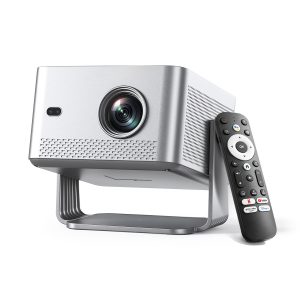
The Magcubic HY450Max is an LCD projector designed for home entertainment. It combines native 1080P resolution, Android 14, and automatic image adjustment features, making it suitable for living rooms, bedrooms, and other home entertainment spaces.
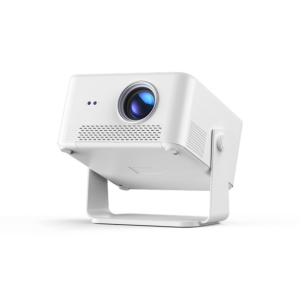
7.3 Magcubic M800GT vs. HY450Max: Specification Comparison
Both the M800GT and HY450Max feature native 1080P resolution. Their brightness ratings are 840±10% ANSI Lumens and 800 ANSI Lumens, respectively. Their main differences are in optical design, operating systems, processors, and audio configurations.
| Specification | M800GT | HY450Max |
|---|---|---|
| Native Resolution | 1080P | 1080P |
| Brightness | 840±10% ANSI Lumens | 800 ANSI Lumens |
| Throw Ratio | 1:1 | Not specified on the website |
| Operating System | Linux + Google TV | Android 14 |
| Processor | Allwinner H137 | Allwinner H726 |
| RAM / Storage | 1GB / 32GB | 2GB / 16GB |
| Focus | Auto Focus | Auto Focus |
| Keystone Correction | Auto | Auto |
| Obstacle Avoidance | Supported | Supported |
| Wireless Connectivity | Specific version not specified on the website | Wi-Fi 6, Bluetooth 5.4 |
| Speakers | 1 × 12W | Dual 12W |
| Maximum Supported Input | 8K@24fps | 8K@24fps |
For consumers who prefer Google TV and a fully sealed optical structure, the M800GT is worth considering. For those who prioritize Android 14, wireless connectivity, and dual speakers, the HY450Max may be a better fit.
8. Frequently Asked Questions About ANSI and ISO Lumens
What is the difference between ANSI Lumens and ISO Lumens?
ANSI Lumens is a projector brightness measurement based on relevant ANSI measurement methods. ISO/IEC 21118:2020 is an international standard that specifies information and formats for data projector specification sheets. Both are related to projector light output, but they should not be treated as exactly the same in terms of their technical purpose.
How many ANSI Lumens do you need for a 100-inch projector screen?
There is no single brightness requirement that works for every 100-inch screen. In a bedroom with good light control, a relatively lower-brightness projector may be suitable. In a living room with natural light, a brighter projector may be needed. Screen gain and viewing conditions also affect the final result.
Are ANSI Lumens and LED Lumens the same?
No. ANSI Lumens refers to projector brightness measured using a relevant measurement method, while LED Lumens is often used to describe the brightness of an LED light source or as a marketing brightness rating for a projector. If the manufacturer does not clearly state the measurement method, LED Lumens should not be directly compared with ANSI Lumens.
Do higher ANSI Lumens mean a sharper projector image?
Not necessarily. Higher brightness can improve image visibility in suitable conditions, but resolution, contrast ratio, color accuracy, and optical quality are equally important. Brightness and image sharpness are two different aspects of projector performance.
How many ANSI Lumens are suitable for a home theater?
For a home theater where ambient light can be controlled, Magcubic’s current brightness guide recommends approximately 800–2,000 ANSI Lumens for a 100–120-inch image. The right choice still depends on the room, screen, and personal viewing preferences.
How can you check whether a projector’s brightness rating is accurate?
Check the product specifications, the stated brightness measurement standard, and the test report for the specific model. For professional purchasing, it is also important to confirm that the model and testing configuration in the report match the actual product being purchased.
Conclusion
ANSI Lumens and ISO Lumens are both important references for understanding projector brightness, but they are not directly interchangeable, and there is no universal conversion formula that applies to every product.
When choosing a projector, you should look beyond the brightness rating and also consider native resolution, contrast ratio, optical system, and the actual viewing environment. Taking all these factors into account will help you achieve a better viewing experience.
XINYIHUI specializes in LCD projector research and development and manufacturing. With a professional R&D team and modern production facilities, we have capabilities in product development, manufacturing, and quality control.
Through our MAGCUBIC brand, we continue to offer home projectors with different brightness levels, resolutions, and smart features, providing a range of home entertainment solutions for consumers worldwide.
We also work with global business partners through wholesale distribution, OEM/ODM services, and customized solutions.