From home theaters to corporate boardrooms, and from school classrooms to outdoor entertainment, projectors have become an indispensable visual medium in modern life. Unlike many everyday tech devices, the projector was not invented by a single individual. Instead, it evolved over hundreds of years through continuous breakthroughs in optics, mechanical design, display technology, and digital innovation. This article traces the history of projection technology from its earliest optical roots to today’s smart projectors, laying out the complete lineage of how the technology came to be.
I. The Roots of Projection: What Was the Earliest Form?
1. Optical Principles Before the Invention of Projectors
The earliest concept of projection can be traced back to the Camera Obscura (Latin for "dark room"). Through a tiny pinhole, light from an outside scene passes into a darkened room or box, casting an inverted image on the opposite surface. This optical phenomenon was observed in ancient times, with Aristotle among those who documented similar effects.
During the Renaissance, advancements in lens grinding made it possible to focus and enlarge these light-borne images using convex lenses. This laid the optical groundwork for the later invention of the "Magic Lantern." Without the accumulated knowledge of camera obscura and lens technology, the projector as we know it would never have come to exist.
.png)
II. Who Invented the First Projector?
1. Christiaan Huygens and the Magic Lantern
Christiaan Huygens (1629–1695) was a Dutch mathematician, astronomer, and physicist. Around 1659, Huygens built the first practical, working "Magic Lantern." In a letter to his brother, he detailed the exact design of the device. Around the same time, his friend, the Jesuit priest Andreas Tacquet, used a similar setup to display projected slides.
The Magic Lantern relied on a straightforward design: a lantern body containing a candle or oil lamp as the light source, a mirror at the back to reflect and boost the light, and a lens fitted at the front. Painted glass slides were placed in front of the light source, and the image was magnified through the lens onto a wall or sheet. This core configuration—Light Source + Image Carrier + Focusing Lens—remains the fundamental design logic of projectors today.
During this same period, the German Jesuit scholar Athanasius Kircher described a similar device in his writings and claimed credit for its invention. Meanwhile, Danish mathematician Thomas Rasmussen Walgensten was the first to name the device "Laterna Magica" (Latin for "Magic Lantern"). Walgensten traveled across Europe giving public demonstrations, which truly popularized the Magic Lantern across the continent.
III. The Historical Journey: From Magic Lantern to Smart Projector
Phase 1: 17th to 19th Century — The Era of Optical Projection
For over two centuries after the Magic Lantern was introduced, projection technology stayed mostly within the optical framework of "light source + glass slide + lens," seeing only incremental refinements. Early lanterns used candles or oil lamps, which produced limited brightness and required pitch-black rooms for small audiences.
In the early 19th century, the introduction of Limelight (produced by heating quicklime with an oxyhydrogen flame) and later carbide lamps dramatically raised brightness levels. Magic lanterns were soon adopted for church sermons, classroom teaching, and large slide shows. Phantasmagoria—traveling theater shows that used hidden magic lanterns to project terrifying ghost figures—became a popular craze across Europe.
Phase 2: Late 19th to Mid-20th Century — The Era of Film Projectors
In the late 19th century, the maturation of photography and film stock drove a massive leap in projection technology: shifting from static glass slides to moving images, giving birth to the motion picture projector. Pioneers like the Lumière brothers combined photographic film, mechanical gears, and optical projection to bring moving pictures to the big screen for the first time.
During this era, projectors moved beyond niche educational and theatrical uses to birth the global movie industry, permanently altering how humanity experiences entertainment and information.
Phase 3: 1950s to 1990s — The Commercial and Educational Era
By the mid-20th century, projectors entered classrooms and corporate offices on a massive scale, producing two iconic types of equipment:
- Slide Projectors: Exemplified by the Kodak "Carousel" slide projector, users loaded 35mm film slides into a circular tray. A light bulb illuminated the film, and a lens magnified and projected the photos sequentially onto a screen. This setup became a fixture for sharing family vacation photos, running corporate training, and delivering academic lectures.
- Overhead Projectors (OHPs): The direct forerunner to modern classroom projectors. Instructors placed transparent plastic sheets containing handwritten text or diagrams onto an illuminated stage. Light shone upward through the sheet, and a top-mounted mirror and lens projected the content onto a screen or wall. Because OHPs were simple to operate and worked in well-lit rooms, they quickly became standard equipment in schools and conference rooms, remaining popular until digital projectors took over in the early 2000s.
.png)
Phase 4: 1990s to 2010 — The Digital Projection Revolution
As computers and digital imaging advanced, projection technology underwent its most significant transformation: transitioning from optical film to fully digital projection. Instead of using physical film or transparencies, the source image now came from computer graphics or video signals. Three main technologies emerged during this era:
- LCD Projection: Uses liquid crystal panels to control light passage. Red, green, and blue light streams are individually modulated and combined to form the final image. Known for strong color reproduction, LCD was the dominant projection method throughout the 1990s and early 2000s.
- DLP (Digital Light Processing): Developed by Texas Instruments, DLP relies on a microchip covered with millions of tiny microscopic mirrors (a Digital Micromirror Device, or DMD). By rapidly tilting each mirror to control pixel brightness, DLP produces high contrast, crisp details, and compact device sizes, making it a popular choice for home theaters and business setups.
- LED Light Sources: Traditional projectors relied heavily on halogen or UHP (Ultra-High Performance) lamps, which suffered from high heat output and short lifespans. The introduction of solid-state LED light sources extended bulb life to tens of thousands of hours, cut power consumption, reduced maintenance costs, and allowed projectors to shrink in size—paving the way for portable home projectors.
Phase 5: 2010 to Present — The Smart Projector Era
After 2010, the focus of projector development shifted from simply "getting a clear picture" to "making the experience smart." Integrated smart operating systems (such as Android) meant users no longer needed external computers or TV boxes to stream content or install apps. Features like auto-focus, automatic keystone correction, and intelligent obstacle avoidance made setup virtually plug-and-play.
At the same time, mature laser light sources brought higher brightness, richer colors, longer lifespans, and better eye comfort. Projector designs also diversified: moving from traditional ceiling-mounted commercial units to portable mini projectors, laser TVs, and ultra-portable pocket projectors.
Brand Spotlight: Magcubic
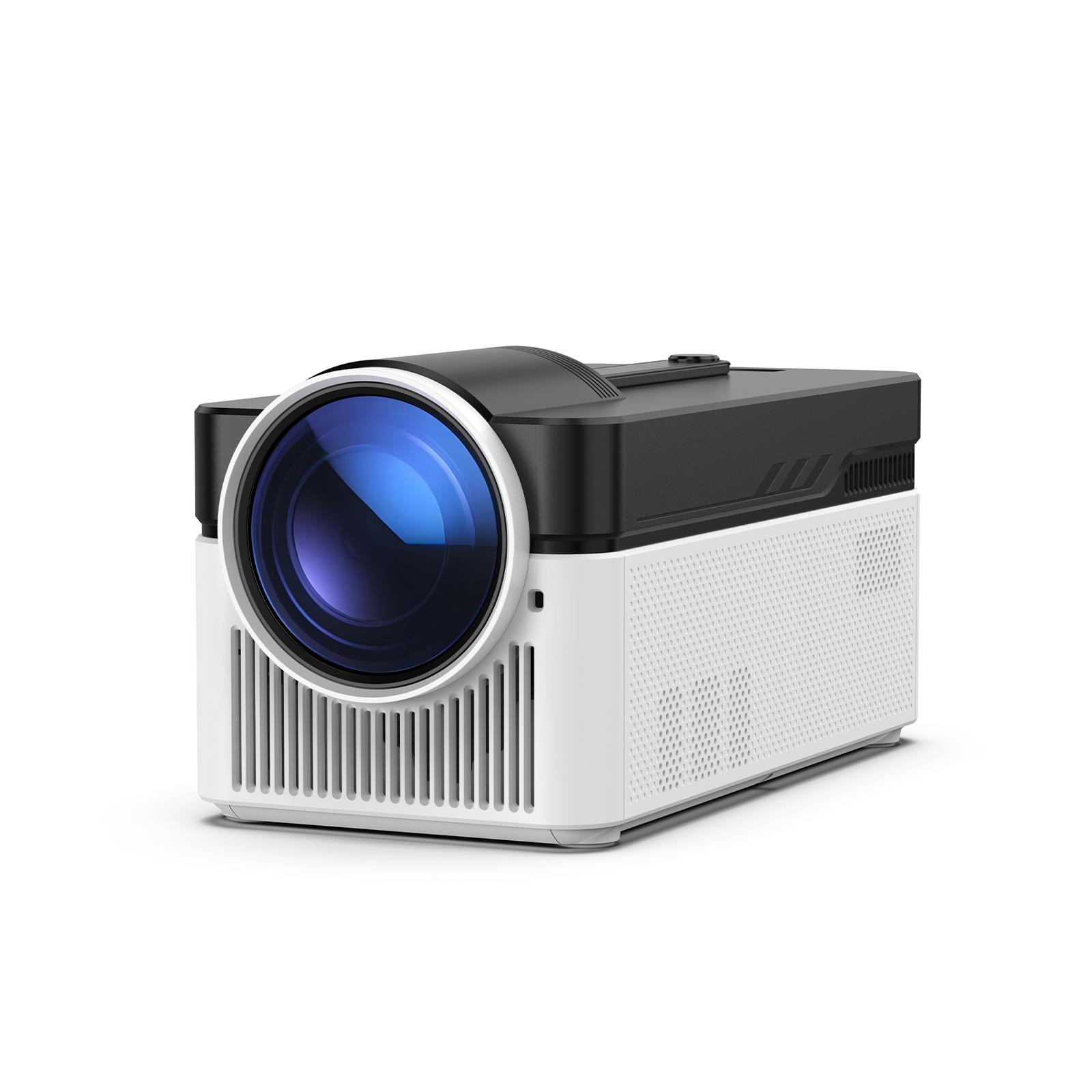
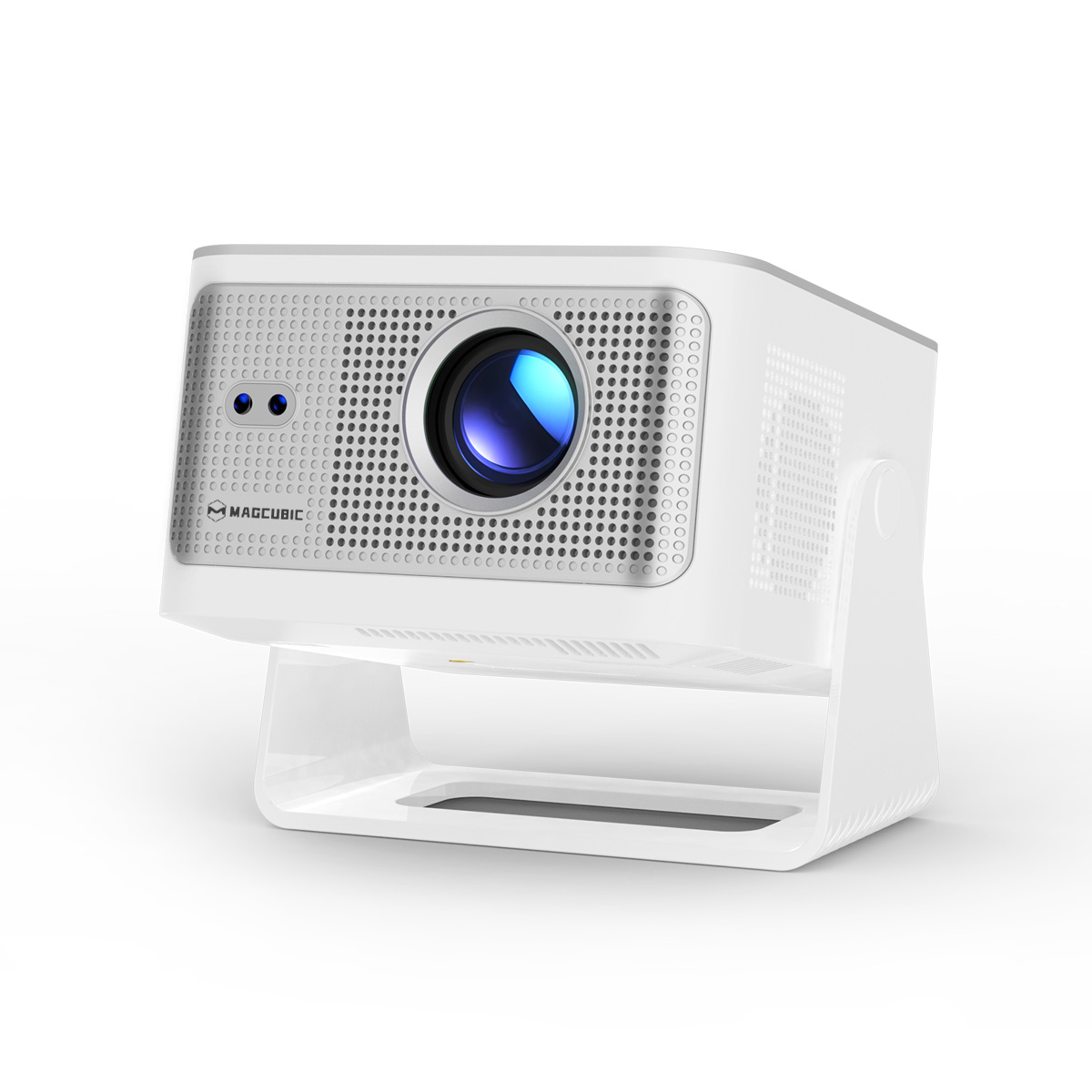
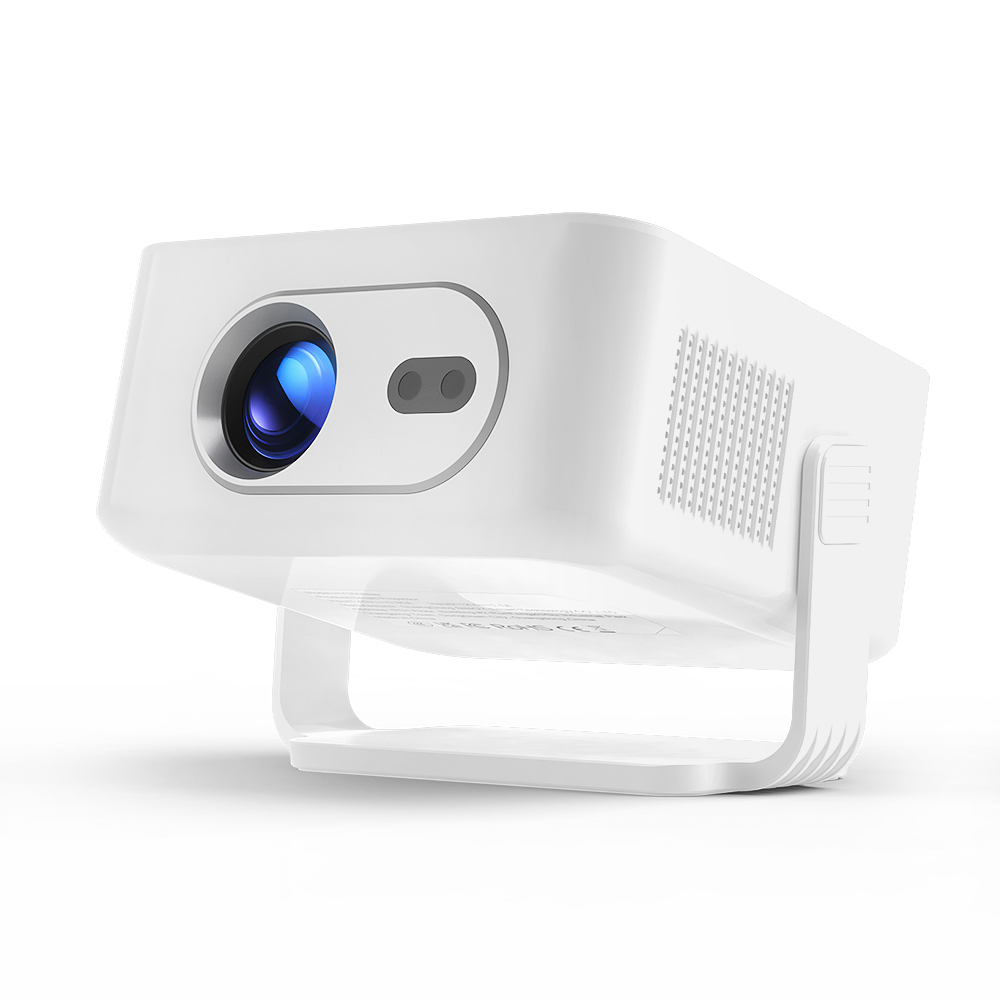
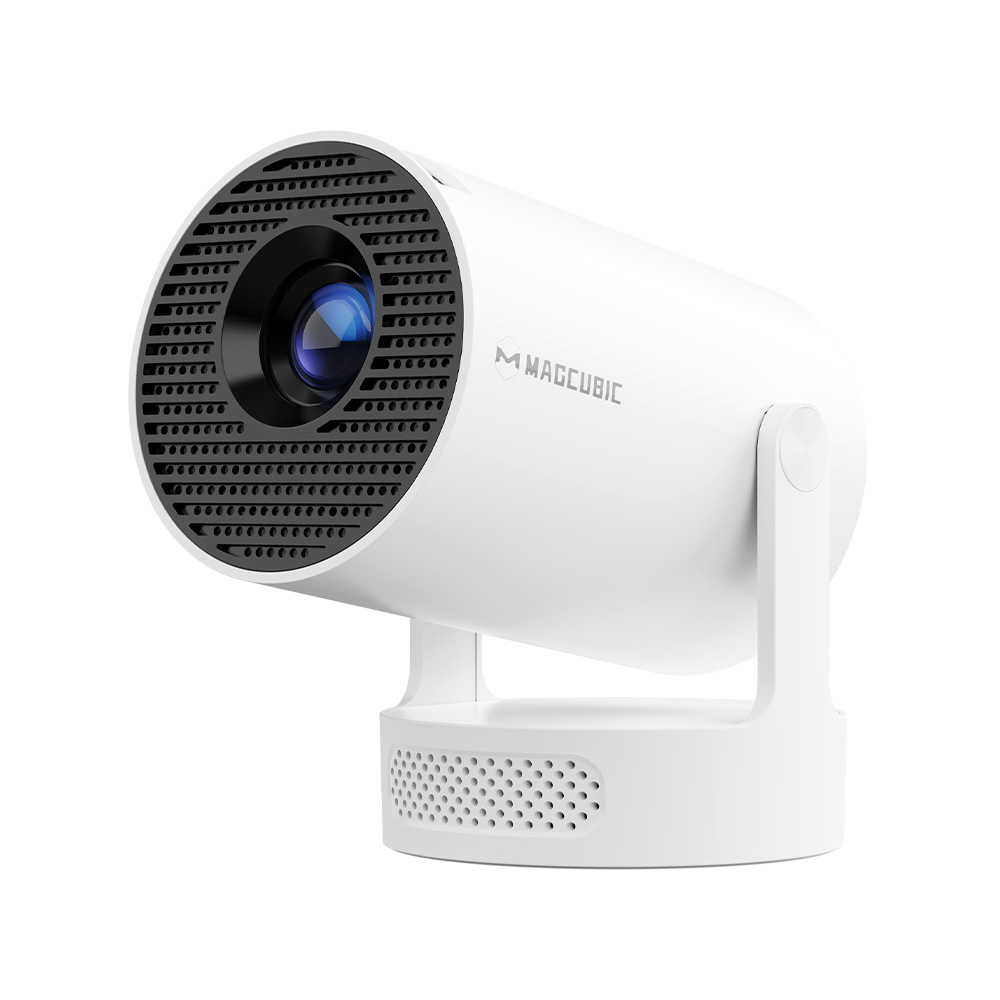
Magcubic is a projector brand focused on smart LCD devices. Its product line covers multiple operating systems, including Android, Google TV, and Netflix-certified systems (NTV). In terms of hardware formats, Magcubic offers both portable and home-use models: portable units are lightweight and compact for travel or camping trips, while home-use models feature higher brightness and stronger built-in audio for living rooms and bedrooms. Standard smart features—such as auto-focus, auto-keystone correction, wireless screen mirroring, and dual-band Wi-Fi—come standard across its lineup, delivering feature-packed functionality at budget-friendly price points.
.png)
IV. Key Technological Breakthroughs in Modern Projectors
Comparing a modern projector to Huygens' Magic Lantern reveals two entirely different worlds, though both share the same underlying optical logic. The main breakthroughs include:
- Evolving Light Sources: Evolving from candles, oil lamps, and limelight to halogen and UHP bulbs, and finally to modern LED and laser systems—delivering exponential gains in brightness, operating life, and energy efficiency.
- Digital Image Generation: Shifting from hand-painted glass slides and developed film to LCD and DLP digital microchips, completely replacing physical media with digital data signals.
- Smart Features and Connectivity: Built-in operating systems, wireless casting, voice control, auto-keystone correction, and auto-focus have turned specialized technical equipment into easy-to-use consumer electronics.
- Compact Portability: Evolving from bulky setups that required dedicated darkrooms into mini units that fit easily inside a backpack or pocket.
- Color and Resolution: Progressing from black-and-white silhouettes and hand-colored slides to modern 4K resolution with HDR support, providing unprecedented color accuracy and image sharpness.
V. Future Trends in Projection Technology
Looking ahead, projection technology is likely to continue evolving along these key paths:
- Widespread Adopted RGB Laser Sources: Triple-color laser technology will become more common, offering purer color saturation and higher brightness alongside lower energy draw.
- Higher Visual Standards: Higher native resolutions (such as 8K) and High Dynamic Range (HDR) processing will transition from high-end commercial hardware into mainstream consumer products.
- Deeper AI and Smart Interaction: Automated image alignment, smarter voice assistants, and gesture controls will become smoother and more intuitive, reinforcing the projector's role as a smart home hub.
- More Form Factors: Ultra-short-throw designs, laser TVs, wearable micro-projectors, and spatial projections integrated with AR/VR will open up new design possibilities.
- Expanded Everyday Uses: Expanding beyond home entertainment and classrooms into automotive displays, outdoor projection mapping, commercial exhibits, and ambient lighting.
Conclusion
Looking back at over three centuries of development, projection technology has come a long way—from Christiaan Huygens holding a candle inside a wood-and-metal Magic Lantern to today's pocket-sized, internet-connected 4K smart projectors.
While Huygens laid the groundwork for the first practical device, the credit for bringing projectors into everyday life belongs to generations of scientists and engineers who continuously pushed the boundaries of optics, electronics, and digital technology. Understanding this history is not just about tracing the growth of a piece of hardware; it is about witnessing humanity's endless curiosity and passion for capturing light and shadow.